

Comparing Machine Learning Models for Predicting SMEs’ Financial Condition Using Explainable AI
In the European economy, small and medium-sized enterprises (SMEs) are considered the backbone of economic development, representing around 98% of businesses. Accurate and transparent financial prediction is particularly important for SMEs, which often operate under limited analytical resources and rely on delayed or traditional financial assessments. Accordingly, this study investigates how effectively different machine learning models can predict the financial condition of SMEs and which model provides the most reliable predictions. In addition, explainable AI techniques are applied to clarify how predictions are formed and to identify the financial indicators that most strongly influence the results, thereby supporting data-driven decision-making in SME contexts.
In today’s modern, data-driven world, almost everything is rapidly changing with technology, saving time and money while improving accuracy. In this data-driven environment, businesses depend heavily on data to make decisions. They want to change their work methods to suit the competitive market.
Artificial Intelligence (AI) has become an important tool for improving business, making it well-suited to the modern economy. AI-based systems rapidly improve business functions and day-to-day operations. Machine learning, as a subset of AI, enables computers to learn from data after identifying hidden patterns and exploring large datasets faster than humans. It can also support real-time analysis and improve prediction accuracy.
However, SMEs often face difficulties due to limited resources and expertise. They usually face a lack of finance, technology, and expertise; these factors are highly crucial for SME development. Therefore, it is timely to support SMEs to create AI-based solutions. AI is widely recognised as a key enabler of improved financial performance in SMEs. AI assists SMEs in automating daily financial tasks, handling large volumes of financial data, and generating analytical insights. This establishes quick, more accurate, and up-to-date financial decision-making. In a modern data-driven environment, businesses are heavily dependent on making sound financial decisions. SMEs would reduce their risk and costs and improve customer satisfaction by accessing accurate, real-time financial data. Therefore, system development is an excellent aid in making realistic decisions using financial indicators.
Data and methods
Financial ratios are key quantitative tools for assessing a company’s financial health. For managers, analyzing these ratios is important for achieving steady growth and long-term profitability. Financial performance in SMEs is commonly assessed using indicators such as profitability, liquidity, leverage, efficiency, turnover, and growth. This study continues to use the open-source Polish company bankruptcy dataset from the UCI Machine Learning Repository. For this study, 1 to 3 years of data to assess trends over the year was chosen. Data was preprocessed to improve the data quality. The final dataset contains 27,703 observations and 64 standard financial ratios.
In the modern data-driven economy, businesses use ML and DL models for prediction and decision-making. However, some predictions cannot be explained clearly due to system complexity, a phenomenon known as the black-box problem. Explainable Artificial Intelligence (XAI) is the greatest solution for this problem, and using an XAI model can generate decisions in a human-understandable way, improving transparency, fairness, trust and privacy. SHapley Additive exPlanations (SHAP) is one of the key tools for XAI. The SHAP value visualises how much each feature contributes to the predictions by calculating the average impact of the feature across all possible combinations. This approach ensures fairness and regulatory compliance in predictive modelling compared to other XAI methods (such as LIME).
This thesis developed machine learning models to predict financial conditions for SMEs and to compare different ML models to identify the most efficient approach for accurate prediction. Explainable Artificial Intelligence (XAI) is also highlighted in this study as a solution to the “black box” problem of machine learning models. XAI helps to improve transparency and trust by explaining decisions made by machine learning models. This assists SME stakeholders in making reliable and user-friendly decisions.
Results
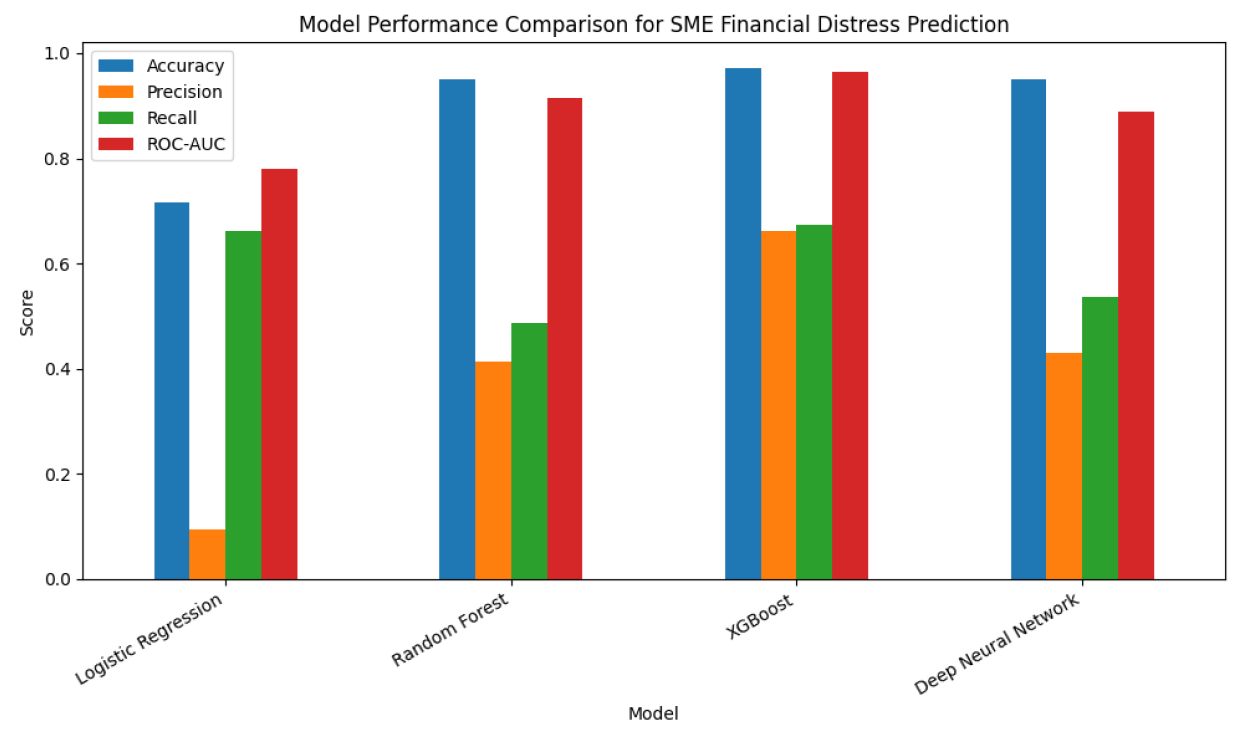
The results showed clear performance differences among the Logistic Regression, Random Forest, XGBoost, and Deep Neural Network models in both the training and test datasets. Logistic Regression served as a baseline model. It had acceptable sensitivity but limited predictive value due to its linear nature. Random Forest improved classification, accuracy and stability by capturing non-linear relationships. XGBoost consistently delivered the best performance regarding accuracy, recall, F1-score and ROC AUC, making it the most effective model for predicting the financial condition of SMEs (Figure 1).
XAI tool Shapley Additive exPlanations (SHAP) is employed to explain the predictions of the best-performing model according to the above evaluation. The SHAP value was used to interpret the XGBoost model’s predictions at both global and local levels. By applying SHAP, the study moves beyond simple classification to provide a comprehensive understanding of why certain SMEs are at risk, showing how financial ratios increase or decrease the predicted risk of financial distress.
Among all financial ratios, ratio A27 (Profit on operating activities / Financial expenses) emerges as the most influential indicator. This ratio measures a firm’s ability to generate sufficient operating income to cover its interest. Ratios A46 (Quick Ratio) and A5 (Cash-to-Expenses ratio) follow in importance, highlighting that liquidity and cash management are critical secondary factors in determining financial distress risk. Firms with stronger liquidity positions are, therefore, more likely to be classified as financially stable by the model. In contrast, cost-efficiency indicators negatively affect financial outcomes. The A58 ratio (Total costs / Total sales) is associated with a higher predicted risk of financial distress. This finding confirms that inefficient cost structures significantly undermine financial performance and stability. The Figure 2 bar plot simplifies the complex 64-feature dataset into a prioritized list of indicators that SME managers should monitor to detect early signs of distress.
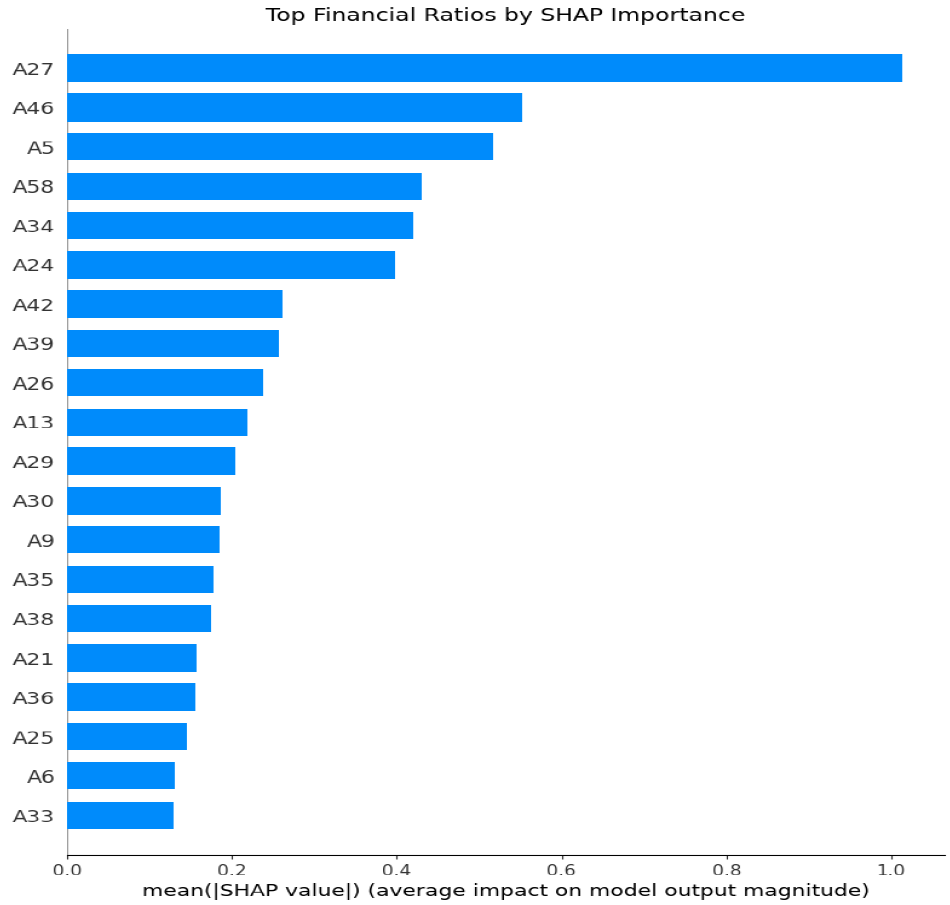
Overall, the SHAP results demonstrate profitability, liquidity, and cost-efficiency ratios that confirm the model’s predictions are not only statistically robust but also financially meaningful, aligning closely with classical financial distress and performance theories. XAI transforms complex machine learning models into practical, understandable decision-support tools.
In conclusion, this study shows that machine learning, especially XGBoost combined with SHAP-based explainable AI, provides accurate and transparent approach for predicting SME financial distress with interpretability. Future work will focus on operationalizing the proposed approach within industrial supplier‑management systems, such as developed in the S4M project in shipbuilding context. The financial prediction system can be expanded into a practical early warning system designed specifically for SMEs as a user-friendly decision-support tool. Moreover, to help larger companies, such as shipyards and turnkey suppliers, in selecting SMEs and other subcontractors, the financial prediction system could automatically send risk alerts and recommendations after reviewing key financial ratios.
Reference
Ranatunga Arachchilage Inoka Jeevani. 2026. Predicting SMEs’ Financial Condition Using Explainable AI. Bachelor’s Thesis. Turku University of Applied Sciences.
Article image: Freepik