
How multilingual parents can support second-language learning in daily family life
Many parents in multilingual families worry that they cannot help their children learn a second language because their own language skills are not fluent. In reality, everyday family life, warm relationships, and mother languages already provide a strong language-learning environment. When parents see the value of their daily routines and choose simple activities that fit their schedules, it becomes much easier to support their children.
Today, more and more children in Finland grow up in families that speak two or more languages every day (Repo et al., 2024, p. 222). Even though kindergartens offer professional language support, children still spend most of their time at home with their parents (Finnish National Agency for Education [EDUFI], 2022, p. 32). When parents know how to use simple daily routines to support a second language, they feel much more confident in helping their children.
Daily family routines create easy chances to hear and use a second language
Some parents believe that supporting a second language at home means setting fixed study times or teaching grammar rules. In fact, young children learn a new language much better through natural communication in everyday life (Bruner, 1983, p. 77). Simple moments like eating meals, getting dressed, walking to kindergarten, and getting ready for bed give children regular chances to hear and use words in real situations. Even a quick trip to the grocery store or a walk outside offers easy ways to name colors, foods, and animals together without adding extra work to a busy schedule.
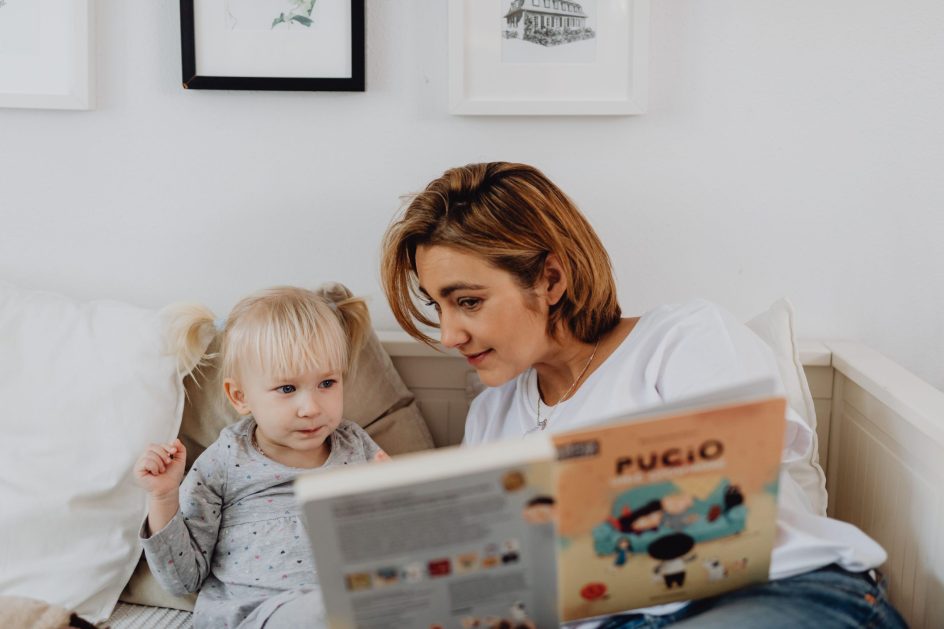
Parents can easily bring a second language into family time by reading books together. They do not need to pronounce every word perfectly or translate every sentence for story time to be helpful. Looking at pictures together, talking about the characters, and guessing what will happen next help children understand the story and enjoy the language. Families can also visit local libraries to borrow picture books, audiobooks, or other materials related to children’s language development.
Age-appropriate audio materials and apps can also support language learning when parents choose them carefully. Listening to children’s songs, short podcasts, or audiobooks while a child is drawing or playing brings natural spoken language into the home. Digital tools work best when parents and children share the experience instead of just leaving a screen on. Asking a simple question or talking about the story afterward turns listening time into real communication.
Home languages and a safe family atmosphere help children learn faster
Parents in multilingual families often ask whether they should stop using their mother tongue so their child can learn a second language faster. Experience in early childhood education shows that home languages do not get in the way of a second language. Instead, the ideas and thinking skills a child learns in their first language help them understand a new language more easily (Cummins, 2000, p. 38). When a child already knows what a concept means in their home language, it is much easier to connect that meaning to new words in English or Finnish.
Children are much more willing to try out a new language when they feel safe and relaxed at home. If children feel tested or afraid of making mistakes, they often become shy and quiet (Krashen, 1985, pp. 3–4). Close family relationships and creative activities, such as singing simple songs, drawing pictures, or acting out scenes from a favorite storybook, allow children to practice new words and mix languages through fun and imagination without feeling embarrassed. Listening patiently and focusing on what the child wants to say builds much more confidence than correcting every small mistake.
Multilingual families also do not need to follow one strict language rule at home. In daily life, families naturally switch between languages depending on the situation, the activity, and who is speaking. Letting children use all their own ways of communicating, such as body language, pictures, home-language words, and new second-language phrases, helps them express themselves clearly (García & Wei, 2014, p. 22). Respecting each family’s own languages ensures that language learning supports the child’s growth and overall well-being (EDUFI, 2022, p. 51).
Open discussions in kindergarten help parents find what works for their family
In early childhood education, supporting children’s language development works best when families and kindergarten staff work together. Kindergartens offer professional, play-based learning environments, while families support children through daily care and home experiences (EDUFI, 2022, p. 35). Even so, many parents feel unsure about what they can actually do at home. Creating open and friendly discussions between educators and families helps parents connect practical ideas with their own daily lives (Lastikka & Lipponen, 2016, p. 76).
A practical outcome of our pair thesis project at an English-medium kindergarten in Southwest Finland was an interactive Parent Evening model for supporting English at home. Instead of a traditional one-way lecture with fixed rules, the session combined brief explanations, hands-on demonstrations of tools like audio boxes and reader pens, and open group discussions. During the event, parents joined the discussions actively, shared their own family experiences, and even took photos of key slides with their phones to save useful ideas for later. This open format proved effective in turning professional knowledge into realistic tips suited to busy family schedules.
Feedback from the post-workshop questionnaire showed that small, everyday changes can make a real difference. Parents shared that they felt much more confident after realizing they did not need to act like language teachers. Right after the workshop, families began trying practical activities at home:
- Listening to English children’s podcasts while drawing or playing.
- Applying for local library cards to borrow picture books and audiobooks.
- Adding regular English bedtime stories to their evening routines.
When parents feel free to choose activities that match their own routines and values, everyday family life becomes a supportive place for second-language learning.
This article is based on the thesis Supporting parental agency in home-based second-language development: developing a parent evening workshop model for multilingual families in ECEC by Shizhong Qiu and Duruo Zhou. This thesis is available in Theseus via the following link:
https://urn.fi/URN:NBN:fi:amk-2026111630577
References
Bruner, J. (1983). Child’s talk: Learning to use language. Oxford University Press.
Cummins, J. (2000). Language, power, and pedagogy: Bilingual children in the crossfire. Multilingual Matters.
Finnish National Agency for Education. (2022). National core curriculum for early childhood education and care 2022. https://www.oph.fi/sites/default/files/documents/National%20core%20curriculum%20for%20ECEC%202022.pdf
García, O., & Wei, L. (2014). Translanguaging: Language, bilingualism and education. Palgrave Macmillan. https://doi.org/10.1057/9781137385765
Krashen, S. D. (1985). The input hypothesis: Issues and implications. Longman.
Lastikka, A.-L., & Lipponen, L. (2016). Immigrant parents’ perspectives on early childhood education and care practices in the Finnish multicultural context. International Journal of Multicultural Education, 18(3), 75–94. https://doi.org/10.18251/ijme.v18i3.1221
Repo, E., Aerila, J.-A., Tyrer, M., & Harju-Luukkainen, H. (2024). Multilingual learning environments in early childhood education in Finland. Journal of Early Childhood Education Research, 13(1), 221–248. https://doi.org/10.58955/jecer.129339