
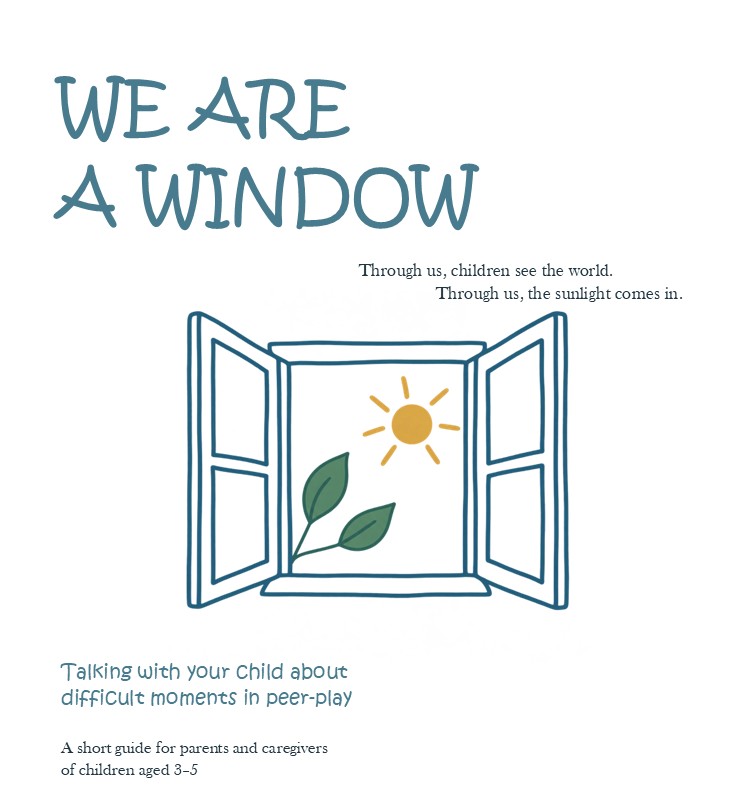
What parents can say when their child has a difficult moment in peer play
Peer play helps young children build friendships and experience belonging, but it can also involve difficulties in joining play or everyday disagreements about toys, roles, or play ideas. When a child comes home after a challenging peer-play experience in daycare, parents may find it hard to know what to say. In my developmental thesis, I used salutogenesis to develop a guide We Are a Window, which gives parents of three- to five-year-olds a place to start. It introduces three aspects that parents can explore with the child: what happened, what matters to the child, and what could help.
Children develop through peer play
Playing with other children is part of daily life in early childhood education and care (ECEC). My developmental thesis focuses on peer-play experiences because peer play offers sustained opportunities for children to interact, build relationships, and experience being part of a group. Early peer play relates to children’s later development and adjustment in some research. One study found that better peer play ability at age 3 predicted lower risk of emotional, peer, conduct, and hyperactivity problems when children turned 7 (Zhao & Gibson, 2023, pp. 1807, 1818).
During peer play, children repeatedly negotiate entry, materials, positions and objects, while alliances shift every now and then (Cederborg, 2020, pp. 779–780, 787–789). This means that ordinary disagreements over toys or play ideas and occasional difficulties in play participation can naturally happen. Even though these ordinary disagreements and difficulties in play participation can sometimes be challenging for children, they are part of children’s social lives and can also offer opportunities for children to learn about emotions, communication, and problem-solving. According to Chen et al. (2001), peer conflicts can provide natural opportunities for young children to develop skills of appreciating others’ perspectives (p. 538).
Three ideas from salutogenesis can guide a conversation at home
Salutogenesis is a theory focusing on resources that help people deal with difficulties and support human health and well-being. Salutogenesis’s central concept is the sense of coherence (SOC), which means people can experience the world as comprehensible, manageable, and meaningful.
In developing my guide, We Are a Window, I translated those ideas into three things parents can explore with a child. The first idea, comprehensibility, can be explored by asking “What happened?” It refers to both how a child feels about an experience and how the child understands the experience. The second idea, meaningfulness, can be explored by asking “What mattered?” It’s about what mattered to the child in the experience. A child may want to join a particular game because they experience fun. They may also care a lot about a toy, role, or friendship. The third idea, manageability, can be explored by asking “What could help?” It’s about parents’ exploring possible next steps with the child’s participation.
Parents can use We Are a Window in their own ways
The guide We Are a Window is available in English and Finnish versions and each language version is 22 pages long. The guide can be shared with parents as part of everyday communication between families and ECEC staff.
The guide consists of three parts: Part 1, “Conversation guide” (pp. 1–6); Part 2, “Play situations” (pp. 7–16); and Part 3, “Ideas and resources” (pp. 17–19).
Part 1 “Conversation guide” explains briefly why challenging peer-play experiences matter to a child. It introduces three aspects that parents can explore with the child: what happened, what matters to the child, and what could help. By explaining these three questions, the guide also introduces what sense of coherence (SOC) means in the context of peer-play difficulties in everyday language. Part 1 also describes five attitudes that can help parents talk with their child and explains how to adapt the suggestions to their own situation. It also reminds readers of the limits of the material and explains when to discuss concerns with ECEC staff.
Part 2, “Play situations” (pp. 7–16) contains five scenario cards. Two illustrate difficulties in play, and two illustrate everyday disagreements during play. The fifth, “When words are few”, illustrates how a guardian can support a child when the child’s words are few. Each card presents a short situation, offers possible responses, and uses a sample conversation to show one of four ways to respond, including Invite (for making a safe space for the child to share), Make sense, What matters, and What could help, by illustrating an example conversation.
Part 3, “Ideas and resources” (pp. 17–19), begins with two illustrated pages that parents and children can look at together when considering what might help. Some options are taking a break, asking an adult for help, using things around them, or practising together. The final page directs parents to activities for exploring feelings through play, an exercise for talking through a disagreement using drawings or toys, and material on helping children feel heard. It also includes a link for readers who would like to learn more about salutogenesis.
References
Cederborg, A.-C. (2020). Young children’s play: A matter of advanced strategies among peers. Early Child Development and Care, 190(5), 778–790. https://doi.org/10.1080/03004430.2018.1491561
Chen, D. W., Fein, G. G., Killen, M., & Tam, H.-P. (2001). Peer conflicts of preschool children: Issues, resolution, incidence, and age-related patterns. Early Education and Development, 12(4), 523–544. https://doi.org/10.1207/s15566935eed1204_3
Zhao, Y. V., & Gibson, J. L. (2023). Evidence for protective effects of peer play in the early years: Better peer play ability at age 3 years predicts lower risks of externalising and internalising problems at age 7 years in a longitudinal cohort analysis. Child Psychiatry & Human Development, 54, 1807–1822. https://doi.org/10.1007/s10578-022-01368-x