
Practical strategies for parents to support children in managing big feelings
A fallen block tower or a broken crayon can bring up big feelings. This article shares simple ways parents can help children aged three to five calm down, name their feelings, and express them safely.
Imagine you have a four-year-old child. When you call the child for dinner, the child’s block tower accidentally falls. The child starts to cry, shout, and pick up a block to throw away. But your calm voice and a few words related to feelings at that moment help your child overcome the situation and manage their own emotions.
Young children learn to manage emotions with our support
The support children need to manage their own emotions varies from one moment to the next. A child who waits for his or her turn patiently in the morning may cry over a broken crayon in the evening. Thümmler et al. (2022, p. 3) state that young children learn to manage emotions gradually through supportive and positive interactions with adults. Between the ages of three and five, children become more capable of managing their own emotions, but they still seek comfort from adults. For instance, a parent can stay nearby and help the child to calm down when they become upset.
The support needed may be different from child to child. Sometimes, between the ages of three and five, a child might tell you what happened, or they may show it by crying, shouting, or turning away. Saarni and Camras (2022, p. 3) state that talking with others helps young children to recognize and understand their feelings. Moreover, the National Core Curriculum for Early Childhood Education and Care (Finnish National Agency for Education [EDUFI], 2022, p. 23) explains that educators should support children to express and regulate emotions and should give children the opportunity to notice, acknowledge and name feelings.
What parents can do to support emotion regulation of young children
As mentioned above, when the block tower falls, a parent might say, “You look disappointed,” “I understand your feelings,” and “You worked hard on this tower.” But if the child starts to throw the blocks away, the parent can remove the blocks and say, “It is okay to become angry, but I won’t let you throw these blocks.” These words demonstrate the parent’s understanding of the child’s emotions, while the actions help ensure everyone’s safety.
During the focus group discussion we held for our thesis with Daycare Daisy in Turku, the educators explained that children should be allowed to calm down before starting to talk about the situation. Silkenbeumer et al. (2024, p. 1) explain what educators can do when children experience strong emotions and how their support may differ depending on the child and what happened. At home, a parent can hug the child if they need it or can give them a little space to calm down. After that, a parent can allow the child to calm down and discuss the situation. As an example, a parent can ask, “What should we do if the tower falls like this again?”
We conducted a parental survey for our thesis. The survey findings indicated that parents already support children’s emotion regulation through hugs or physical closeness. The findings highlighted a need for practical guidance on how to support emotion regulation of children when children find it difficult to manage their emotions.
Play and stories give children time to practice
Telling a bedtime story to a child gives an opportunity to talk about feelings. A parent can imagine a character and build a story related to a challenging emotional situation or read a book related to emotions. A parent can ask several questions about the character in the story, such as “How do you think Nalle feels?” or “How can we help Nalle?” A parent can encourage the child to answer by using words, by pointing to a picture or by showing emotions through facial expressions.
Streubel et al. (2026, p. 1) found a link between how well young children understand and use feeling words and what they already knew about emotions. For instance, a child may want to go to the park, but when the child arrives there, the park is closed. In this situation, the parent can approach the child by saying, “I know that you were really excited to play but now I think you are feeling disappointed as the playground is closed.” The child hears the word “disappointed” in this situation, and this provides the child with a concrete example. Later, when something similar happens, a child might be able to recognize the feeling and use the same word.
National Core Curriculum for ECEC 2022 (EDUFI, 2022, p. 38) explains that group play can be used as a setting to practice children in regulating their emotions and taking other people’s views into account. A parent can organize games similar to these situations and help a child to practice how to cope with different emotions. Moreover, the guidebook included simple age-appropriate activities and several calming strategies such as using a calm corner with calming toys, breathing exercises, and nature walks. Parents can practice these activities when the children are calm and later when they need it, the activity is already familiar, and it may be more effective.
Home and daycare can share what works
The National Core Curriculum for ECEC 2022 (EDUFI, 2022, pp. 32-33) emphasizes that mutual respect, trust, and sharing children’s strengths, vulnerabilities, and daily experiences with families are important. During pick-up or drop-off times, parents and educators can discuss the child’s day and identify what works well and what does not work well with the child. As an example, the educator might say that the child finds it easier to stop an activity or go outside to play when they already know what happens next. A parent might mention that a short reminder before bedtime might help the child at home.
As a team, we delivered our outcome as a guidebook named Help Me to Help Myself in collaboration with Daycare Daisy to support parents in emotion regulation of children aged three to five. Our thesis and the guidebook were informed by a focus group discussion with the educators, a parental survey, an evaluation workshop, and a strong theoretical foundation.
Remember that, as mentioned at the beginning of this article, the next time your child’s tower falls, your child might feel upset. As a responsible adult, you can help the child to calm down and name the emotions while keeping everyone safe. With your support in everyday moments similar to this, your child may gradually learn to regulate emotions and find ways to express them safely.
This artical is based on the thesis A guidebook for parents to support emotion regulation of children aged 3-5 by Wannakuwattewaduge Melanie Rochelle Fernando, Niyomali Urszula Gamage, Senarath Paranagamage Chamarika Nuwandi Madushani. The thesis is available in Theseus via the following link: https://www.theseus.fi/items/7a86166e-9d0b-480e-beea-b75248304a9b
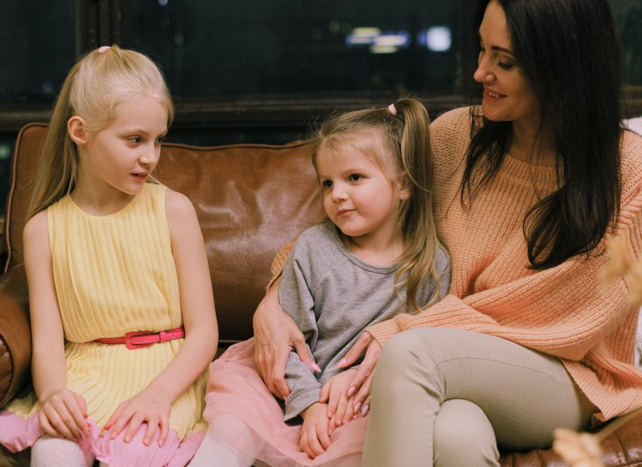
Main image: Mother sitting on a sofa with her daughters.Photograph by Anna Shvets from Pexels. Used under the Pexels License. https://www.pexels.com/photo/woman-sitting-on-sofa-with-girls-11368551/
Reference
Finnish National Agency for Education. (2022). National core curriculum for early childhood education and care 2022. https://www.oph.fi/sites/default/files/documents/National%20core%20curriculum%20for%20ECEC%202022.pdf
Saarni, C. & Camras, L. A. (2022). Emotional development in childhood. Encyclopedia on Early Childhood Development. https://www.child-encyclopedia.com/emotions/according-experts/emotional-development-childhood
Silkenbeumer, J., Lüken, L. M., Holodynski, M., & Kärtner, J. (2024). Emotion socialization in early childhood education and care – How preschool teachers support children’s emotion regulation. Social and Emotional Learning:Research, Practice, and Policy, 4, 100057. https://doi.org/10.1016/j.sel.2024.100057
Streubel, B., Khammous, N., Saalbach, H., & Gunzenhauser, C. (2026). Emotion-specific vocabulary is associated with preschoolers’ emotion knowledge and behavioral emotion regulation. Scientific Reports, 16, Article 5414. https://doi.org/10.1038/s41598-026-38847-3
Thümmler, R., Engel, E.-M. & Bartz, J. (2022). Strengthening emotional development and emotion regulation in childhood—As a key task in early childhood education. International Journal of Environmental Research and Public Health, 19(7), Article 3978. https://doi.org/10.3390/ijerph19073978