
Boosting travel chains in Turku: From car use to sustainable mobility
Why do many people choose the car in a compact city like Turku, when sustainable options exist? In this project,153 non‑users of public transport across Turku were interviewed to better understand everyday travel choices. The study was carried out by Capstone students at Turku UAS as part of the City of Turku’s mobility development work, in cooperation with the city and funded by Traficom through a state grant. The article combines the results of the project with the group’s own thoughts on how sustainable mobility could be better supported in everyday life.
The City of Turku aims to become carbon-neutral by 2029 and increase the share of sustainable travel modes to 66% by 2030 as part of its climate goals. Car use is still high, and road traffic is the most significant source of emissions in the city, accounting for around 34 % of total emissions in 2024. The impacts of traffic are also visible in safety and health. Traffic-related injuries occur every year, and transport-related emissions have been linked to premature deaths in Turku. (Statistics Finland, 2023; City of Turku, 2024.)
For these reasons, it is important to increase the share of sustainable travel modes and to understand what the barriers to their use are.
Figure 1. Share of modes of transport in trips within Turku (Finnish Transport and Communications Agency Traficom, 2024).
The City of Turku already collects feedback from current public transport users, but less is known about people who rarely or never use public transport or shared mobility services. Why do they choose other ways of travelling, and what would make sustainable mobility more attractive for them? What issues do people have in their daily travel chains? A travel chain means one journey made by combining different modes of transport, such as walking to a bus stop, taking a bus, and then using a city bike or walking to the final destination.
To explore these questions, students at Turku University of Applied Sciences carried out a study as part of the Capstone Innovation Project in spring 2026. The study is part of the “Boosting travel chains” project, led by the City of Turku, with the aim of better understanding residents’ mobility needs and improving travel chains based on both existing data, and user feedback. The project is funded by Traficom through a state grant for mobility management.
As part of the project, interviews targeting non-users of public transport were conducted across different parts of Turku. The results of these interviews are integrated into the city’s planning process, helping the city develop mobility solutions that are easier for people to use.
Methodology
The data was collected through short face-to-face interviews in 22 different locations in Turku during March and early April 2026. The locations included for example supermarkets, shopping centres, residential areas and campuses. We focused on residents who do not use public transport or use it only a few times a year. Each interview started with screening questions. If the interviewee was a resident of Turku, and didn’t use public transport often, we would continue the interview further.
Picture 1. Group member Elina Rantamäki conducting an interview at Lemminkäisenkatu campus.
Picture 2. Group member Toni Juvonen conducting an interview at Lemminkäisenkatu campus.
The interviews usually lasted around three minutes and focused on everyday travel choices, barriers to using public transport, and ideas for improving sustainable travel chains.
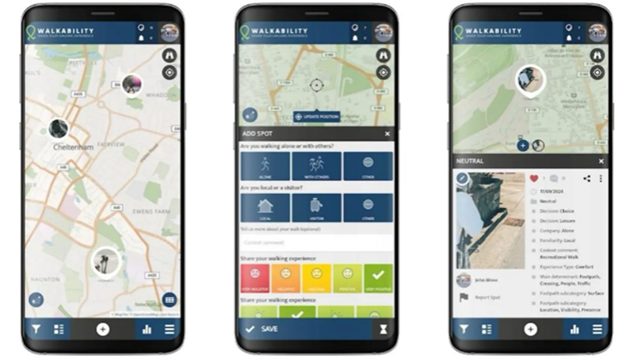
As part of the assignment, we tested out the Walkability app. Walkability is an open‑source mapping tool designed to geotag and categorize walking-related barriers in cities. The platform can be used via a smartphone app or web. (Active Cities Interreg North Sea, 2025). Walkability can be accessed via https://www.spotteron.com/walkability/.
When relevant, we would ask if the interviewees had any suggestions for improving the walking, bus, and bicycle infrastructure. Place‑specific issues such as poor lighting, missing benches or unsafe crossings were recorded using the app.
Picture 3. Screenshots from the Walkability app.
As a small reward, respondents received a Föli day ticket for Turku’s public transport, which functioned as a gentle nudge to encourage trying public transport. Alongside the ticket, we handed out an information leaflet about the project, with a link where they can read more about the project.
In total, 179 responses were collected. From these answers 26 were excluded from the final analysis due to incomplete data, misunderstandings during the interview process, or because the responses did not fit the criteria, making the total of qualified responses 153.
Results
Basic demographic information was collected to describe the sample and provide context for the results. The data included the respondents’ age group, gender, postal code, public transport use, and the language of the interview. These variables were used to ensure that the sample was representative of Turku residents. The following two figures show the gender and age distribution of our interviews.
Figure 2. Gender distribution (n = 153)
Figure 3. Age distribution (n = 153)
The survey included open-ended questions, where respondents described their main reasons for not using public transport, challenges along their routes, and possible improvements. These responses provided additional insight into everyday barriers, such as travel time, inconvenience, safety concerns and habitual car use. Below are presented some selected responses, shortened and translated into English:
“Paalupaikka and Satakunnantie feels unsafe to cross. I don’t know which bus to use, since the lines changed.”
”Cycling paths in the Port Arthur district are too narrow.”
”Paalupaikka and Satakunnantie feels unsafe to cross. I don’t know which bus to use, since the lines changed.”
“A bus stop shelter is missing next to the Steiner-school in Martti. Waiting for the bus uncomfortable in the rain.”
153 open answers were collected and categorized, and are shown in this table:
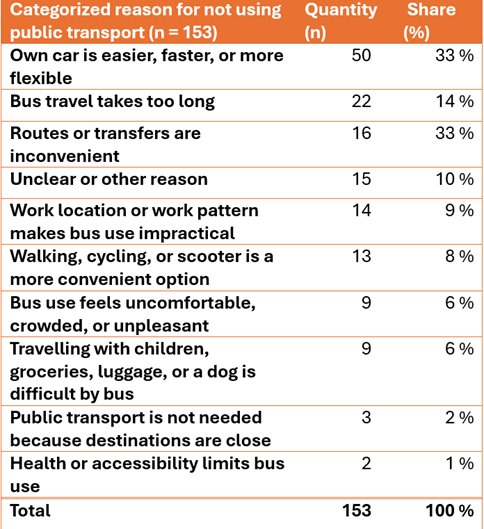
Table 1. Categorized reason for not using public transport (n = 153).
The most common reasons for not using public transport were that private cars are more convenient, buses take too long, and routes and transfers feel inconvenient. A surprisingly large share of responses were unclear or categorised as “other,” often reflecting habits such as automatically choosing the car or not being aware of alternative options. Many respondents also expressed a preference for using alternatives like cycling or walking instead of the bus.
Since buses are a key part of travel chains, an important question is why people choose not to use the bus, and how this barrier could be reduced. Many responses suggested that the issue is not just connected to one factor, but a combination of convenience, time, and habit. When the car feels easier and more flexible, even small inconveniences in bus travel can discourage use.
We also examined which other sustainable modes of transport people would like to use as part of their travels. Cycling, walking and e‑scooters were rather popular, with cycling receiving particularly positive feedback in Turku. Many respondents felt that the city has become easier to cycle in. Some criticism was also brought up, and these issues were documented separately in our data and, where relevant, through the Walkability app.

Figure 4. Categorized reason for not using public transport (n = 153).
Walkability app results
In total, 18 issues related to walking and cycling were recorded in the Walkability app. The main observations included:
– Narrow sidewalks and cycle paths where pedestrians and cyclists share space
– Poor lighting on routes and around bus stops
– Lack of bus shelters
– Poor or missing paths leading to stops
– Unsafe crossings
– Poor visibility
Although the number of results collected was limited, we received valuable and concrete examples. The results showed what kind of data the app can provide and how useful it could be if it was used on a larger scale.
What could make sustainable mobility easier?
The interviews showed that many people are interested in more sustainable ways of moving around Turku. However, if the car is still the fastest, most flexible and most comfortable option, it is understandable that many people continue to choose it.
One of the clearest recommendations is to make bus travel faster and more reliable. Many respondents said they would be more open to using public transport if it was a more competitive option compared to the car. This could mean giving buses more priority in traffic, using bus lanes, traffic light priority and better bus stop spacing on main routes. The recent trunk line renewal of the bus network was also mentioned several times. Particularly in areas such as Hirvensalo, Student Village and Perno–Pansio respondents felt that bus travel had become more complicated.
Cycling was one of the most positive findings of the project. Many respondents saw cycling as an enjoyable and pleasant way to move around the city, as Turku is rather compact and many distances are relatively short. For cycling to become an even better alternative to car use, biking needs to be plasant, fast, safe, and routes have to be direct without unnecessary detours. There is also a demand for better winter maintenance, safer intersections and more secure bicycle parking, especially near bus stops and travel hubs.
Picture 4. Föli city bike.
Walking and cycling safety was also mentioned in the results. Respondents referred to issues such as poor lighting, narrow paths, unsafe crossings, and missing benches or shelters. Based on these responses, infrastructure issues appear to greatly affect how easy and comfortable it feels to walk, cycle, or reach public transport.
The interviews also showed that some transport options are still not very visible. Car sharing, e‑cargo bikes and park‑and‑ride services were rarely mentioned. This suggests that many people do not see them as realistic options for everyday travel just yet. These services need clearer visibility, better locations and stronger integration into the public transport system. Park‑and‑ride, for example, could become a more attractive option if it was easier to recognise, better signed and clearly connected to Föli routes.
Pricing
An idea that came up during the project was related to ticket pricing. Some families mentioned that bus travel can feel relatively expensive or inconvenient compared to using a car. After this, a group member who is an exchange student from Germany, looked into examples from their home city, where “group tickets” exist. These are used to make public transport more affordable for families and small groups. A similar group or family ticket in Turku could be one possible way to make public transport more attractive for families.
Föli bus tickets currently include a two-hour transfer period at no additional cost. One concrete idea would be to include Föli city bikes in the current two-hour transfer period. This would allow users to try out new travel modes easily.
Easy and seamless connections
Transfer points and hubs are an important part of successful travel chains. If people change modes from one mode to another, the location of the interchange needs to feel safe, clear and comfortable. Bus stops, especially along trunk routes, should have good shelters, seating, lighting and bicycle parking.
The Föli trunk line network is designed around transfers, even though our survey results pointed out that many users do not necessarily prefer them. This makes it even more important to ensure that transfers are as seamless and convenient as possible. Ideally, connections should be easy to find without needing to search for them. For example, park‑and‑ride areas should be located right next to bus stops, and shared options like e‑scooters or city bikes could be available directly at or near the stop. A travel chain can easily break if waiting feels unpleasant or if the transfer is confusing.
Travel chains themselves were not always a familiar concept to respondents. Many people preferred to think in terms of one main mode, such as car, bus or bicycle, not taking other modes into account. This shows that travel chains need to be made simple and visible.
The Föli Journey planner, Reittiopas can already support this by showing how a trip could combine cycling, park‑and‑ride and bus travel, but these options need to be easy to understand and compare. Currently, many of these options remain somewhat hidden in the Journey Planner by default, and if users do not actively look for them, they may not discover them at all. Making these features more visible and easy to use could help lower the threshold for using travel chains.
Picture 5. Screenshot from the Föli Journey Planner, suggesting to combine a bus with a city bike.
The findings we received suggest that interest in sustainable mobility already exists. The challenge is to make these options feel practical in the daily life. Faster buses, safer cycling routes, better walking conditions, clearer information and more visible shared mobility services could all help lower the threshold for trying something new.
The detailed survey results will be delivered directly to the City of Turku for use in the ongoing Boosting Travel Chains project. We look forward to seeing how mobility patterns in Turku develop in the coming years, and how the results of this project can support more user-friendly and sustainable travel.
Picture 6. Members of the project (part of the team). From left to right: Elina Rantamäki, Ida Hagström, Iwar Haaslahti, Pradeepa Kotalawala, Gihan Perera, Toni Juvonen.
We would also like to thank Stella Aaltonen, Anna-Kaisa Montonen and the City of Turku for their support, Annika Kunnasvirta for mentoring and coaching, and all the residents of Turku who took the time to participate in the interviews.
Disclaimer: An OpenAI large language model, provided by Turku University of Applied Sciences, was used to support parts of the data summarisation and analysis, as well as text summarization. All outputs were reviewed by the authors, who take full responsibility for the content of this article, and results of this project.
References
Active Cities Interreg North Sea. (2025). Measuring walkability experiences with the Walk21 app. [online] Available at: https://www.interregnorthsea.eu/active-cities/news/measuring-walkability-experiences-with-the-walk21-app [Accessed 16 Apr. 2026].
City of Turku. (2024). Sustainable Urban Mobility Plan of Turku. https://www.turku.fi/sites/default/files/document/kestavan-kaupunkiliikkumisen-suunnitelma.pdf
Finnish Transport and Communications Agency Traficom. (2024). Henkilöliikennetutkimus 2021: Turun kaupunkiseutu [National Travel Survey 2021: Turku region]. https://www.traficom.fi/files/media/file/HLT%202021%20seuturaportti%20Turun%20kaupunkiseutu.pdf
Statistics Finland. (2023). Road traffic accidents statistics. https://pxdata.stat.fi/PXWeb/pxweb/fi/StatFin/StatFin__ton/
Photo references
Picture 1. Elina Rantamäki conducting an interview at Lemminkäisenkatu campus. Photo taken by Toni Juvonen.
Picture 2. Toni Juvonen conducting an interview at Lemminkäisenkatu campus. Photo taken by Ida Hagström.
Picture 3. Walkability app screenshots. https://walk21.com/
Picture 4. Föli city bike. Photo taken by Iwar Haaslahti.
Picture 5. Screenshot from the Föli Journey Planner. Example visualised by Toni Juvonen.
Picture 6. Members of the project (part of the team). From left to right: Elina Rantamäki, Ida Hagström, Iwar Haaslahti, Pradeepa Kotalawala, Gihan Perera, Toni Juvonen. Photo taken by Thu Mac.