
How Cognitive Technologies Enable Practical AI Solutions in Manufacturing Facilities
Cognitive technologies can help manufacturing companies by turning data into practical support for operators, maintenance teams, and decision-makers. The most useful AI solutions do not start with technology itself, but from concrete shop-floor problems such as downtime, defects, energy waste, and slow access to information.
AI systems require several amounts of data to be implemented, which generally is not a problem as manufacturing facilities produce a large amount daily, from sensors, cameras, defects, or notes. Such data is often found scattered across different systems, notes are not stored in the same systems as defects, or camera carputers, making the data relatively useless. Cognitive technologies allow data to be stored in a singular or branched system, where it is used on its entirety for supporting operators’ tasks, with pattern recognition, anomaly detection, automated inputs/outputs, and decision making.
These AI systems are thought as an additional layer on existing workflows, and existing centralized systems, such as ERP, SCADA, MES, and PLC; as they use existing data with the feature of making it more efficient without taking away the creation of an optimal workflow, making it more reliable and actionable (Ahangar et al., 2025).
Practical AI starts from real production problems
To have a successful deployment of an AI system, the main area of focus is the problem, which should be measured and understood (Agility at Scale, n.d.). There are several repetitive problems across manufacturing facilities independently from their industries.
Such problems and inefficiency are:
- unplanned downtime and machine failures
- quality defects, scrap and rework
- inefficient energy use
- slow access to technical information
- repetitive manual reporting and human bottlenecks
If we consider the food industry, they often struggle with quality and contamination. The Metallurgic industry struggles with machine degradation and unplanned stops. The automotive industry struggles with defects and quality assurance. Even though they are all different industries, they all have measurable problems which can be fixed or made more efficient with a suitable AI system.
Different technologies solve different problems
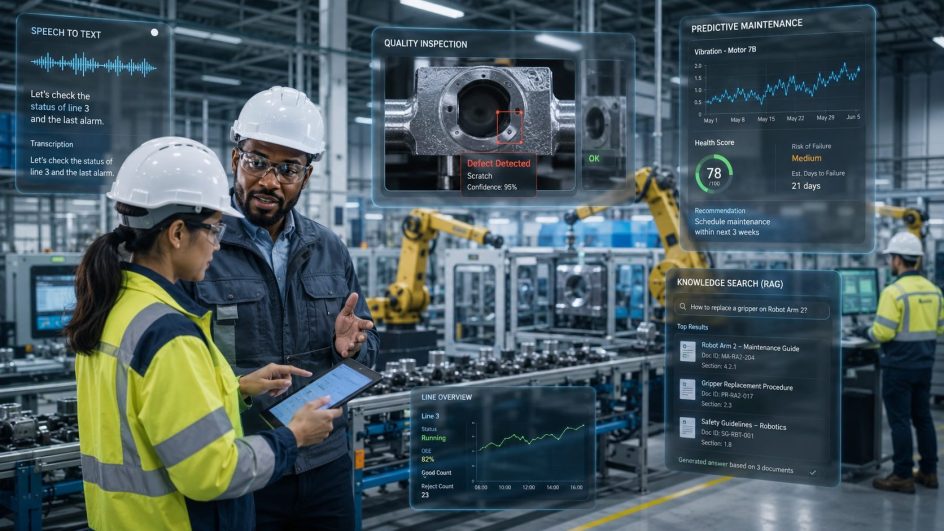
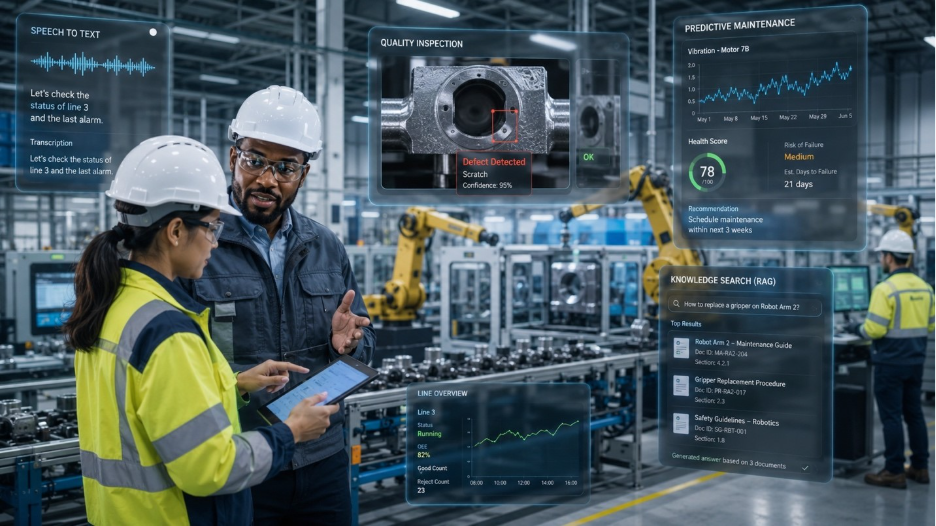
Perception technologies are the most used in manufacturing facilities, with computer vision, screen character recognition, and speech recognition modules. These modules use cameras to detect defects, such as product defects or labeling errors; speech recognition uses microphones to detect spoken instructions and report them in text.
Knowledge and language systems, with embedding, RAG, text to speech, and LLMs modules. Embedding and RAG modules are used to collect all different type of data and made accessible through one source quickly and efficiently; text to speech is used to send spoken alerts to operators’ headsets; LLMs are used across different tasks usually combined with other modules as embedding or vision modules, allowing operators to ask queries and receive a context based output.
Prediction and support systems, with anomaly detection, and predictive maintenance modules. These modules are very useful in heavy machinery which go through brakes and maintenance issues often. These modules are trained to estimate when maintenance is required before an accident takes place (Freire et al., 2024).
Integration decides the success
Practical AI deployments depend on how successfully they are integrated with everyday workflow; defect detection model should not only recognize a defect, but it should also send information to the right system or operator, an anomaly detection model should not only create a warning, but it should also support maintenance planning as well. For this reason, AI implementation should start with piloting first with recurring problems, measure the impact, improve, and then scale (Accela AI, n.d.).
Human-centered AI supports operators
AI should support human work, instead of autonomously managing decisions which can lead to several problems of quality, breakdowns, or safety risks. For such reason, human decision making is essential, as operators understand exceptions, human environments, and relations. The most valuable AI systems then being the one which provides information, alerts, or recommendations to operators, which can verify and approve (European Commission, 2024).
From technology hype to measurable value
Cognitive technologies are valuable when, AI deployments are directly connected with repetitive problems or inefficiencies providing measurable outcomes, which can be estimated in reduced downtime, faster troubleshooting, energy efficiency, lower scarps, and faster data research.
The main conclusion is clear; manufacturing companies do not need to deploy AI systems at once across all their facilities, they can start with one concrete and measurable problem, use available data, deploy AI systems in existing workflows, and measure the outcome. This gradual integration approach makes AI more realistic and useful for manufacturing facilities (Accela AI, n.d.).
Thesis:
Muhammad, Q. (2026). Research on cognitive technologies for implementing AI solutions in manufacturing facilities. Theseus.fi. http://www.theseus.fi/handle/10024/922800
Sources:
Accella AI. (2026, March 11). Deploying AI on the shop floor: Why scaling still lags. https://www.accella.ai/deploying-ai-on-the-shop-floor/
Agility at Scale. (2026, March 17). AI use case identification and prioritization: A framework for identifying and ranking. https://agility-at-scale.com/ai/ai-strategy/ai-use-case-identification-and-prioritization/
Ahangar, M. N., Farhat, Z. A., & Sivanathan, A. (2025). AI trustworthiness in manufacturing: Challenges, toolkits, and the path to Industry 5.0. Sensors, 25(14), 4357. https://doi.org/10.3390/s25144357
European Commission. (2024). Industry 5.0. https://research-and-innovation.ec.europa.eu/research-area/industrial-research-and-innovation/industry-50_en
Freire, S. K., Wang, C., Foosherian, M., Wellsandt, S., Ruiz-Arenas, S., & Niforatos, E. (2024). Knowledge sharing in manufacturing using large language models: User study and model benchmarking. Frontiers in Artificial Intelligence, 7, Article 1293084. https://doi.org/10.3389/frai.2024.1293084
The picture was AI generated, using GPT image generation.