
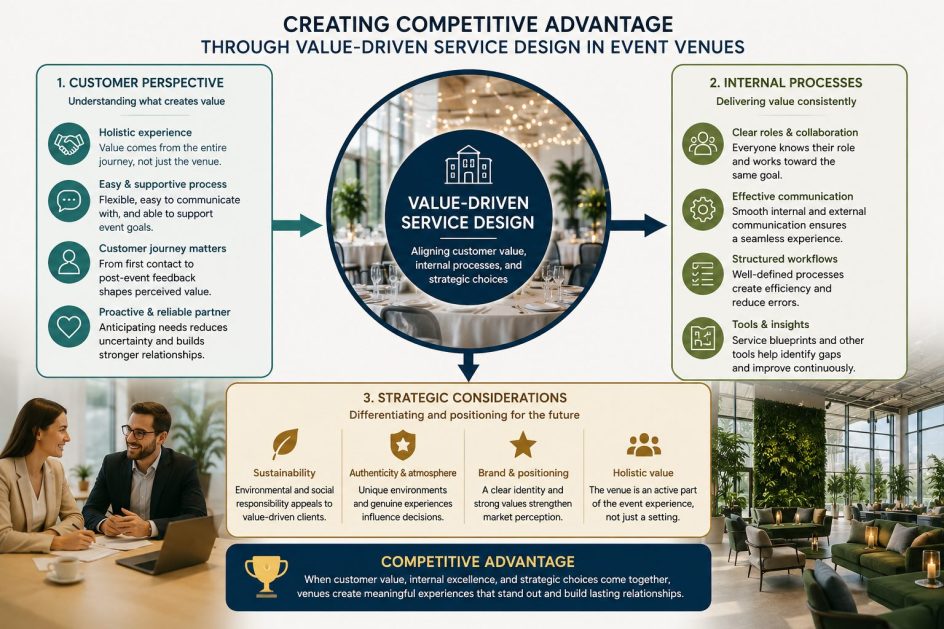
How can event venues create competitive advantage through value-driven service design?
The business event industry has become increasingly competitive, and venues are expected to offer more than just functional spaces. In the past, factors such as location, capacity, and price were often the main criteria when selecting a venue. However, expectations have shifted, and event organizers now place greater importance on overall experience and value. This raises an important question: how can event venues create competitive advantage through value-driven service design? Based on the master’s thesis (Lindqvist, 2026) research results this article approaches the question by examining customer expectations, internal service processes, and broader strategic considerations.
Value is no longer created only through the physical characteristics of a venue, from the customers’ perspective. Instead, it emerges from the holistic experience and the ease of the planning process. Event organizers often look for venues that are flexible, easy to communicate with, and capable of supporting the specific goals of the event. The entire customer journey from the first contact to post-event feedback plays an important role in shaping how the service is perceived. When a venue provider is active and able to anticipate needs, it can reduce uncertainty and build a deeper connection with the customer. In this sense, value-driven service design helps venues stand out by aligning their services more closely with customer expectations.
The ability to deliver added value depends strongly on internal processes. From the service provider’s perspective, competitive advantage is linked to how well the organization functions behind the scenes. Clear roles, effective communication, and well-structured workflows are all essential for ensuring the service experience. Tools such as service blueprints can help visualize these processes and identify potential gaps. Internal processes and collaboration are therefore not just operational concerns but directly connected to how customers experience value. In a competitive market, venues need to offer something unique. Sustainability has become part of this discussion, as many organizations consider environmental and social responsibility when selecting an event venue. Integration of sustainable practices into service design can strengthen a venue’s brand and image and appeal to value-driven clients. Elements such as authenticity and atmosphere can also influence decision-making. These factors contribute to a more holistic understanding of value, where the venue is not just a setting, but an active part of the holistic experience.
In conclusion, competitive advantage in event venues is not based on a single factor, but on how different elements come together. Customer expectations define what is considered valuable and internal processes determine how well that value can be delivered. At the same time, strategic choices, such as sustainability and positioning, influence how the venue is perceived by the market. Value-driven service design can be seen as a way to connect these dimensions and create a more meaningful service offering.
Lindqvist, M. (2026). Improving Venue Selection in Business Events Through Value Creation and Service Design. Master’s Thesis. Turku University of Applied Sciences.
Image: Creating Competitive Advantage Through Value-Driven Service Design in Event Venues. Note. Figure created with ChatGPT (OpenAI), based on the author’s synthesis of the findings from Lindqvist (2026).