
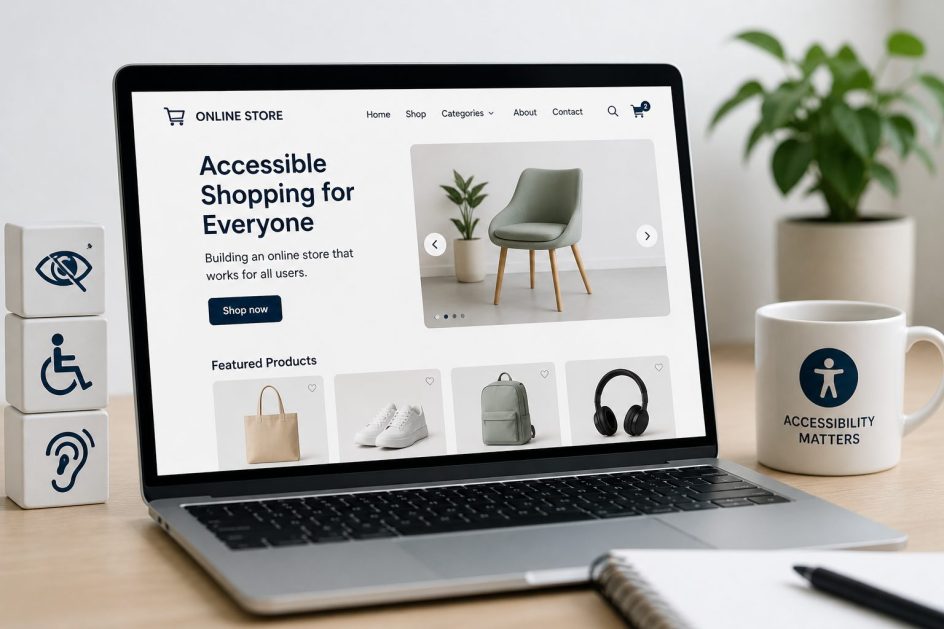
Can You Build an Accessible Online Store Without Coding?
Online shopping keeps growing, and more businesses need simple and affordable ways to build their own online stores. At the same time, accessibility has become an important part of web development. A website should work for everyone, including people who use screen readers or navigate using a keyboard.
In my thesis, I explored whether it is possible to build an accessible online store using a low-code approach. Instead of traditional programming, I used WordPress, WooCommerce, and Elementor together with a ready-made theme. The goal was to see how far these tools can go in creating a functional and accessible e-commerce website.
Why Low-Code Makes Building Online Stores Easier
One of the biggest advantages of this approach is how fast and easy it is. WordPress provides the basic structure, WooCommerce adds the online shop features, and Elementor allows you to design pages visually. This means you don’t need advanced coding skills to create a working online store.
Another benefit is cost efficiency. Since WordPress and WooCommerce are free, and many themes and plugins are affordable, the overall cost stays low compared to custom-built solutions. It is also possible to build a basic online shop in a relatively short time, even within a few days.
Accessibility Still Requires Careful Decisions
However, accessibility is not something that happens automatically. Even though the tools support it, the developer still needs to make the right decisions.
For example, images need proper alternative text, headings should follow a logical structure, and colour contrast must be clear enough to read. Keyboard navigation also needs to be tested to make sure users can move through the site without a mouse.
This shows that accessibility depends more on the developer’s awareness than on the tools themselves.
Benefits and Limitations of the Approach
In my project, I built a complete online store and evaluated it based on accessibility principles from WCAG 2.2. The results showed that it is definitely possible to create a reasonably accessible website using a low-code approach.
At the same time, there are some limitations. More complex features may require additional plugins or custom development. Also, achieving a very high level of accessibility can be challenging without deeper technical knowledge and more thorough testing.
Final Thoughts
Overall, the low-code approach offers a practical and realistic solution for small businesses, students, and individual developers. It makes building an online store more accessible in terms of both cost and skills.
However, if accessibility is taken seriously, it must be considered throughout the entire development process, not just added at the end.