
Beyond Watching Videos: Creative Ways to Use Digital Tools in ECEC
Digital Learning in ECEC
The use of digital devices is part of the lives of children, and at the same time they can be used to facilitate learning in ECEC settings. The mere use of digital devices does not lead to learning, and children need to engage in exploration, creation, communication and participation, instead of only being passive consumers of videos (Undheim, 2022, pp. 481–484). According to the Finnish National Agency for Education (2022, pp. 23–24), digital competencies are part of learning and participation in ECEC in Finland. Such competencies can be developed through play, exploration and problem solving.
Creativity and Exploration Using Digital Media
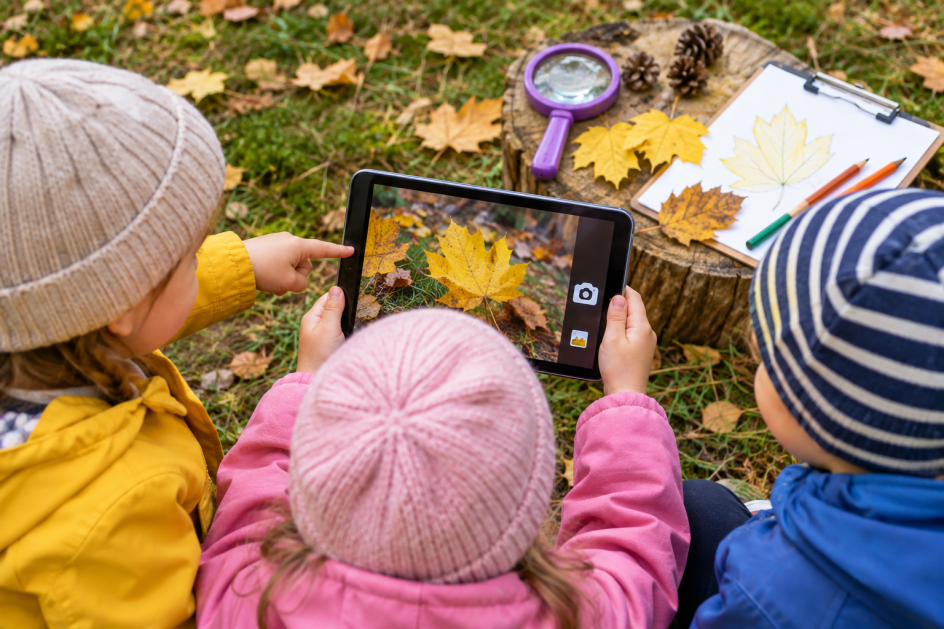
Digital devices may be helpful for creative development if used in combination with conventional techniques. Children might draw their favorite characters and make a digital story using a tablet device. With help from adults, children may order pictures and make audio recordings of their own voice. It means that it is possible to combine art, storytelling and digital technology (Merjovaara et al., 2020, pp. 101–103). Children can also take photographs or videos using cameras or tablet devices during nature walks. They may later look at them and discuss all the things they have found. Staff can also take photographs of the same tree in different seasons and teach children to distinguish differences.
Collaboration and Participation
Digital activities can help children collaborate and exchange information. For instance, children can write a story collaboratively. A child will draw a character, a second one will tell what to do next, while the other will arrange them. In such a way, children will develop listening skills, cooperation and responsibility sharing (Merjovaara et al., 2020, pp. 111–112). Children that have problems with verbal communication can benefit from using digital activities. Everyday situations depicted in photographs can help children show what they want to do – paint, play or go outdoors. Nonetheless, digital activities are supposed to facilitate communication rather than substitute direct interaction (Undheim, 2022, pp. 484–485).
Supporting Staff in Meaningful Digital Learning
The personnel working in ECECs is also very important in organizing digital learning activities. It is important to take into consideration the age, interest, and individual needs of children when deciding about digital activities. It is not recommended to organize activities involving digital technology without a specific educational goal, Lindeman et al. (2021, pp. 4885–4896), and the personnel’s digital competencies, Dardanou et al. (2023, pp. 4–7). In our bachelor’s thesis, we conducted research related to the use of digital tools by ECEC staff during children’s education and activities in a private daycare in Turku. The research results have shown that the digital technology was used by the staff during the learning activities, music activities, communication, and documentation. Still, there were some difficulties, such as lack of resources, technical problems, etc. (Gautam et al., 2026). Digital learning is not an alternative to the physical play, physical activities, reading, or personal communication. It is supposed to provide further possibilities for exploration, communication, and creation for children. With proper aims and involvement, digital technologies can become a useful tool in the daily education process in ECEC (EDUFI, 2022, pp. 23–24, 37; Undheim, 2022, pp. 481–484).
This article is based on a Bachelor’s thesis Digital tools in early childhood education and care by Niraja Gautam, Sanjeev Magar and Nitesh Tharu. Thesis is accessible in Theseus via link https://urn.fi/URN:NBN:fi:amk-2026112031587
References:
Dardanou, M., Hatzigianni, M., Kewalramani, S., & Palaiologou, I. (2023). Professional development for digital competencies in early childhood education and care: A systematic review (OECD Education Working Papers No. 295). OECD Publishing. Professional development for digital competencies in early childhood education and care | OECD
Finnish National Agency for Education. (2022). National core curriculum for early childhood education and care 2022. National core curriculum for early childhood education and care
Gautam, N., Tharu, N., & Magar, S. (2026). Digital tools in early childhood education and care [Bachelor’s thesis, Turku University of Applied Sciences]. Theseus. https://www.theseus.fi/handle/11111/408403
Lindeman, S., Svensson, M., & Enochsson, A.-B. (2021). Digitalization in early childhood education: A domestication theoretical perspective on teachers’ experiences. Education and Information Technologies, 26(4), 4879–4903Digitalisation in early childhood education: a domestication theoretical perspective on teachers’ experiences | Education and Information Technologies | Springer Nature Link
Merjovaara, O., Nousiainen, T., Turja, L., & Isotalo, S. (2020). Digital stories with children: Examining digital storytelling as a pedagogical process in ECEC. Journal of Early Childhood Education Research, 9(1), 99–123. Digital Stories with Children: Examining Digital Storytelling as a Pedagogical Process in ECEC | Journal of Early Childhood Education Research
Undheim, M. (2022). Children and teachers engaging together with digital technology in early childhood education and care institutions: A literature review. European Early Childhood Education Research Journal, 30(3), 472–489. Full article: Children and teachers engaging together with digital technology in early childhood education and care institutions: a literature review