
Helping young children manage big emotions: practical strategies for parents
Children have a lot of different emotions, yet they may not know how to cope with them or control themselves. Such feelings as anger, sorrow, or fear may become a reason for children’s crying, screaming, or misbehaviour. Using some knowledge and simple techniques, parents can teach their children to understand and deal with emotions.
Young children need adult support to manage strong emotions
Development of emotions is a significant stage for children’s development. At the age of three to five years old, the child begins to gain the ability to identify, understand, express and control his/her emotions. Nevertheless, these skills are underdeveloped yet, and the child might need help of adults in this process.
Children react differently to their feelings. For instance, a child might start crying when he or she feels sad, get angry at being deprived of their most loved toy, or refuse cooperation when it is time for playing to stop. Children might go silent and withdrawn out of fear or embarrassment.
Emotion regulation is developed through positive relationships and interactions between adults and kids according to Thümmler et al. (2022, pp. 3–5). It implies that emotional competence develops in a child’s life step by step. When a kid learns to recognize and label his or her emotion, he or she still might need assistance with controlling the behaviour. Emotion regulation involves nothing about preventing kids from expressing themselves emotionally. It implies helping children to understand their emotions and learn appropriate behaviours associated with them. Parents can facilitate this process through acceptance, calming reactions, and proper guidance.
Parents can support emotional development through everyday activities
The role of parents in the emotional development of children is crucial since children tend to learn by observing adult behavior. When parents react to complicated situations calmly, they create good examples for their kids. Positive communication and interactions can make children feel comfortable and understood. One way to achieve this goal is teaching kids how to name their emotions. For instance, if a child gets upset because his toy is broken, a parent can say, ”I understand that you are sad because your toy is broken.”
Parents can also recognize their children’s emotions and set boundaries at the same time. If the child feels angry and attempts to strike someone else, the parent can tell him or her, ”Yes, I know you are angry, but it’s not OK to hit.” In this way, the children will realize that all emotions are fine, but certain behaviors are unacceptable. According to Mannerheimin Lastensuojeluliitto (MLL, 2025), positive experiences in childhood between parents and children are vital for children’s healthy development. Listening and giving comfort may be helpful in building relationships with children.
Physical comfort may also be beneficial for children in emotionally challenging times. For example,
- some children may require a hug
- soothing words or someone
- who sits near them
Yet each child is unique, and it is up to the parent to realize what makes his/her child feel safe.
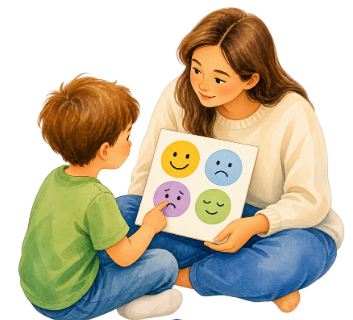
Everyday routines give a chance to develop emotional skills in children. Reading books, talking about the emotions of characters, using emotion cards and playing games can help the child learn emotions. Parents may ask questions like, ”How does the little bear feel?” or ”How can we make the bear happy again?”
Easy techniques to calm can also be helpful for children. In this case, parents may engage in slow breathing exercises, counting exercises, and short breaks, when the child gets frustrated. These kinds of practices are easy for kids to understand in peaceful periods. Positive reinforcement is an effective method for parents as well. When the kids try to show their feelings in the appropriate way, parents may reinforce this kind of behaviour. In this case, for instance, a parent may say, ”You expressed your anger with words not by hitting.” In other words, children respond differently to encouragement. This means that parents must consider the individual needs of their children.
Cooperation between parents and ECEC educators supports children’s emotional development
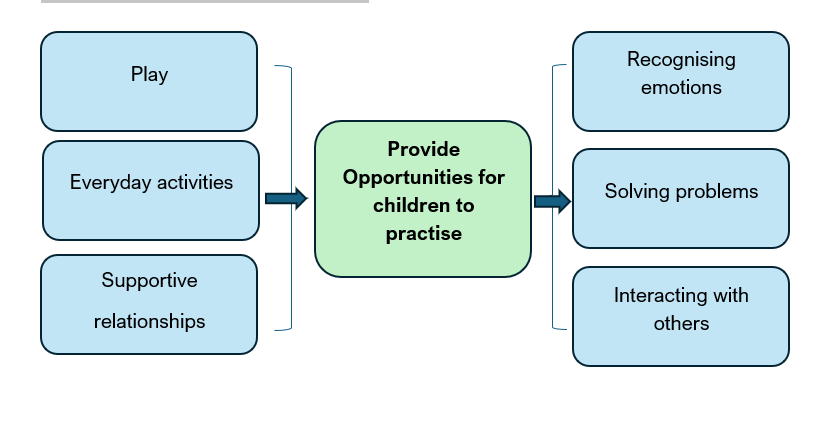
Children spend an important part of their daily lives in early childhood education and care (ECEC). Therefore, cooperation between parents and educators supports children’s emotional development. When adults communicate and share information, they can better understand children’s individual needs. The Finnish National Core Curriculum for Early Childhood Education and Care highlights the importance of positive interactions, emotional development and cooperation with guardians (Finnish National Agency for Education, 2022, pp. 19–23). Through play, everyday activities and supportive relationships, children can practise recognising emotions, solving problems and interacting with others.
As part of our Bachelor of Social Services thesis project at Turku University of Applied Sciences, we created an instructive guide for the parents of children between the ages of three and five years old. This development was done in collaboration with Daycare Daisy in Varissuo, Turku. The purpose of our work was to create an easy-to-understand guide for the parents of children regarding emotion regulation.
During development, we obtained information from the parent survey and the focus group discussion with the daycare educators. The results of the research were that the parents and daycare educators understood the importance of emotional support but had difficulties when children exhibited emotions. An interesting observation was that there were children who recognized their feelings but required adult help in controlling them. The educators also mentioned that the children have problems calming down and resuming group activities after tough emotional experiences. Parents stressed the importance of the physical and communicative comfort. Moreover, they wanted to receive more practical tips, which could be used at home. This information helped to see that parents might appreciate simple examples more than complicated theories. Cooperation between parents and educators can help provide emotional security for the kids. For instance, in case a child encounters problems during transitions, then parents and educators can come up with ways that will work both at home and in daycare.
A practical guidebook can help parents support children’s emotions
According to the theoretical framework and collected information from our project’s developmental period, we have developed a guidebook for parents. In the guidebook, we concentrated on recognition of emotions, coping with powerful emotions, and basic relaxation techniques. Our main goal was to present the collected information clear, attractive, and applicable to families’ daily routine.
This theoretical knowledge helped us to appreciate the significance of adult support in the emotional development of children. As stated by Thümmler et al. (2022, pp. 3–5), young children slowly learn to regulate their emotions due to the supportive involvement of adults. The significance of the reactions and guidance of parents in the emotional development of children is also explained by Zinsser et al. (2021, pp. 377–380). Using this knowledge, we have incorporated some practical techniques such as labeling emotions, comforting, modeling, and positive guidance in our guidebook.
We suggested the practice-oriented information for parents which could be applied in working with kids in order not to concentrate on theories only. Feedback workshop was conducted among the parents and teachers to get feedback on the initial guidebook. The participants liked the language used, the good look of the book and the activities mentioned. They also recommended that we add emotion cards and examples of children’s books.
One parent recommended making up bedtime stories about emotions for kids. It was a great recommendation since it is easy to explore emotions by using stories with imaginary characters and situations. Storytelling can become a part of the daily routine of parents. Yet another notable observation we have made is that each family has its own set of needs. While some parents were happy about the concept of establishing a calming area for the kids at home, there was a parent who believed that it would not work for his child. We have realized that emotional support methods must be flexible enough to fit individual families. Creating the guidebook helped us improve our professional knowledge related to children’s emotional development and family collaboration with ECEC specialists. As future social pedagogues, we have learned the value of listening to parents, respecting their differences and offering them individual recommendations. Helping children with their emotions doesn’t have to involve spending money or doing things that are hard. Simple acts like listening to your child, acknowledging their emotions, reading together, and consoling them could be helpful. With time, positive reinforcement, and good relationships, parents could assist children in developing their emotional skills.
This article is based on the thesis A guidebook for parents in supporting emotion regulation of children aged 3-5 by Wannakuwattewaduge Melanie Rochelle Fernando, Niyomali Urszula Gamage, Senarath Paranagamage Chamarika Nuwandi Madushani. The thesis is available in theseus via the following link : https://www.theseus.fi/items/7a86166e-9d0b-480e-beea-b75248304a9b
Referencers
Finnish National Agency for Education. (2022). National core curriculum for early childhood education and care 2022. Finnish National Agency for Education.
Mannerheimin Lastensuojeluliitto. (2025). Lapsen ja vanhemman varhainen vuorovaikutus. https://www.mll.fi/vanhemmille/tietoa-lapsiperheen-elamasta/vanhemmuus-ja-kasvatus/lapsen-ja-vanhemman-varhainen-vuorovaikutus/
Thümmler, R., Engel, E.-M., & Bartz, J. (2022). Strengthening emotional development and emotion regulation in childhood—as a key task in early childhood education. International Journal of Environmental Research and Public Health, 19(7), 3978. https://doi.org/10.3390/ijerph19073978
Zinsser, K. M., Gordon, R. A., & Jiang, X. (2021). Parents’ socialization of preschool-aged children’s emotion skills: A meta-analysis using an emotion-focused parenting practices framework. Early Childhood Research Quarterly, 55, 377–390. https://doi.org/10.1016/j.ecresq.2021.02.001